

Industrial capital projects carry significant risk. According to research by McKinsey & Company, large infrastructure and industrial projects go over budget by an average of 80% and take 20% longer than planned. Independent oversight is one of the most effective ways to reduce that exposure.
Whether you are building a new processing facility, expanding an existing plant, or upgrading infrastructure in the energy, utility, or oil and gas sectors, the technical and commercial decisions made throughout your project will shape its performance for decades.
Quick Answer: An Owner’s Engineer (OE) is an independent technical advisor hired by a project owner to review engineering, procurement, construction, and commissioning activities across a project’s lifecycle. Their role is to protect the owner’s technical, commercial, and operational interests — from early concept design through to handover and ongoing operations.
Most project owners rely on an EPC (Engineering, Procurement, and Construction) contractor to deliver the work. The problem is that an EPC contractor works in their own commercial interest. The gap between what a contractor delivers and what the owner actually needs is exactly where an owner’s engineer steps in.
This guide explains what an owner’s engineer does, when to bring one on, and how to choose the right firm for your project.
Key Takeaways
- An Owner’s Engineer represents the project owner’s interests — not the contractor’s.
- They provide independent technical oversight across the full project lifecycle.
- Earlier engagement (ideally at FEED) produces the greatest value and risk reduction.
- They reduce the likelihood of cost overruns, design errors, and contractor disputes.
- Owner’s Engineering services apply equally to new builds and brownfield asset upgrades.
What Is an Owner’s Engineer?
An Owner’s Engineer (OE) is an independent technical advisor or engineering firm engaged directly by a project owner. They act as the owner’s representative across the full project lifecycle — from early planning and design through procurement, construction, commissioning, and operations. They are also referred to as a project owner representative, technical advisor for capital projects, or independent engineering consultant.
The defining characteristic is independence. An Owner’s Engineer has no commercial stake in how the project is built or what it costs to deliver. They are not protecting a construction margin or trying to accelerate procurement. Their only accountability is to the project owner.
Think of them as your own technical expert at the table every time a significant engineering or commercial decision is made. They understand the language, the risks, and the standards — so you do not have to navigate those conversations alone.
Owner’s engineering services are widely used in Australia across the energy, utilities, oil and gas, mining, and industrial process sectors. For asset owners managing complex capital investments, independent engineering assurance and project owner representation are not optional extras — they are practical risk management.
What Does an Owner’s Engineer Actually Do?
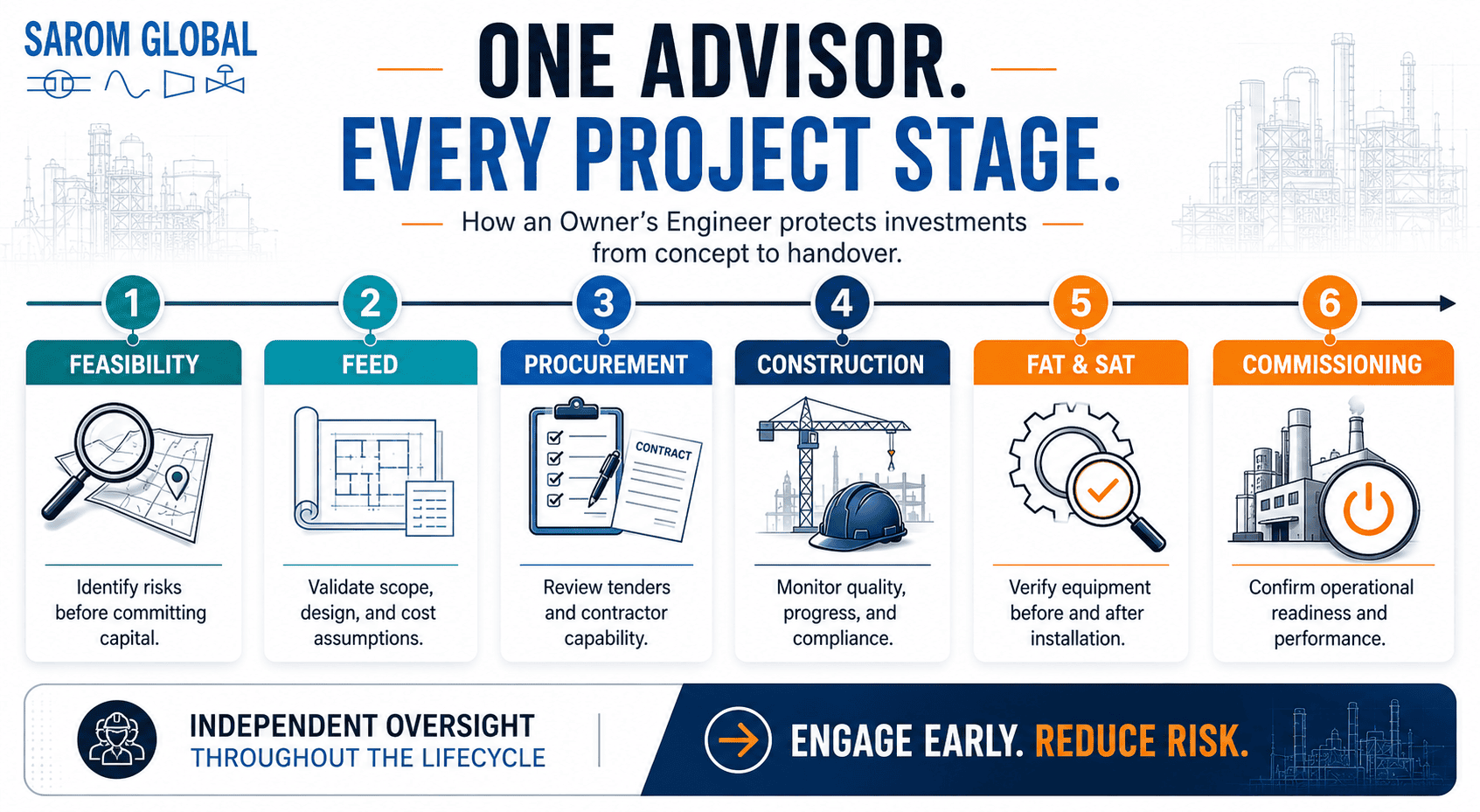
The Owner’s Engineer is involved across every phase of a project. Below is a summary of the key responsibilities by lifecycle stage, followed by a detailed breakdown of each.
Owner’s Engineer Responsibilities by Project Phase
| Project Phase | Owner’s Engineer Role |
|---|---|
| Feasibility | Risk identification, site evaluation, technical due diligence |
| FEED | Design review, scope validation, specification development |
| Procurement | Tender evaluation, contractor selection advice, RFP preparation |
| Construction | Contractor oversight, quality assurance, progress monitoring |
| FAT / SAT | Equipment verification, performance testing, defect identification |
| Commissioning | Startup support, performance validation, handover readiness |
| Operations | Post-completion reviews, warranty support, asset integrity |
FEED Review and Technical Planning
FEED stands for Front End Engineering Design. It is the planning phase where project scope, cost, and technical parameters are defined. The decisions made here shape everything that follows — which is why getting them right matters so much.
As a FEED owner’s engineer, Sarom Global reviews design documentation to check that it genuinely reflects the owner’s requirements. This means verifying that the scope is correct, the design intent is sound, risks are identified early, and technical specifications are realistic and enforceable.
The value of early engagement is significant. Research from the Independent Project Analysis (IPA) group shows that projects with rigorous front-end planning are up to three times more likely to meet their cost and schedule targets than those that rush into detailed design. An Owner’s Engineer is a key part of that front-end discipline.
During FEED, an Owner’s Engineer typically:
- Reviews FEED documentation for scope gaps and technical accuracy
- Validates that specifications reflect the owner’s performance requirements
- Identifies constructability and operability risks before they are locked in
- Reviews cost estimates and schedule assumptions independently
- Prepares or reviews technical inputs for contractor RFP documents
Design Verification and Quality Assurance
Once detailed engineering begins, the Owner’s Engineer independently verifies what the contractor or design house produces. This is not about duplicating the contractor’s work — it is about checking it on behalf of the owner.
Design verification activities typically include:
- Reviewing process flow diagrams, piping and instrumentation diagrams (P&IDs), and equipment schedules
- Checking technical specifications against the owner’s requirements and Australian standards
- Identifying design gaps, errors, or areas for optimisation
- Confirming regulatory compliance is maintained throughout detailed engineering
This is engineering due diligence in practice. Without it, design errors that could have been caught early often surface during construction or commissioning — at significantly higher cost.
Contractor and EPC Oversight
During procurement and construction, the Owner’s Engineer monitors contractor performance and holds them accountable to the agreed technical scope. This includes reviewing deliverables, attending progress meetings, tracking quality milestones, and raising technical non-conformances when required.
Without independent contractor management, project owners regularly discover problems only after they have escalated. A quality issue identified during a construction inspection costs a fraction of the same issue discovered at commissioning.
Example: During a processing facility expansion, an Owner’s Engineer identified a control system integration issue during the FEED review that would have required a six-week redesign had it been discovered during construction. Catching it early saved significant time and rework costs — and avoided a commissioning delay.
Factory Acceptance Testing (FAT) and Site Acceptance Testing (SAT)
Before major equipment leaves the manufacturer’s facility, it should be tested and independently verified. This is the Factory Acceptance Test (FAT). Once equipment arrives on site and is installed, a Site Acceptance Test (SAT) confirms it performs as specified in the actual operating environment.
Sarom Global’s team participates in FAT and SAT activities on behalf of project owners across multiple disciplines and geographies. Equipment deficiencies caught at FAT are resolved at the manufacturer’s cost and on their schedule. The same deficiency discovered after installation can take weeks to address and may delay commissioning entirely.
Learn more about Factory Acceptance Testing and Site Acceptance Testing and how independent participation protects your project.
Commissioning and Operational Readiness
As the project moves from construction to operation, the Owner’s Engineer provides startup support, witnesses performance tests, and confirms the facility is ready for handover. This includes reviewing commissioning procedures, verifying that documentation is complete, and confirming training and maintenance programs are in place.
Commissioning is one of the highest-risk phases of any capital project. This is where design assumptions meet reality — and where gaps in engineering, installation, or documentation become immediately visible. Having an independent commissioning support representative at this stage is one of the most practical protections a project owner can have.
Owner’s Engineer vs EPC Contractor vs Independent Engineer
These three roles are frequently confused. The table below clarifies exactly who each party represents, what they are accountable for, and how their involvement differs.
| Factor | Owner’s Engineer | EPC Contractor | Independent Engineer |
|---|---|---|---|
| Represents | Project owner | Themselves | Lender or financier |
| Primary Objective | Protect the owner’s technical and commercial interests | Deliver the project scope within their own budget | Verify the project is financially viable and compliant |
| Commercial Interest | No stake in project delivery outcome | Direct financial interest in margin and cost | No stake; scope is typically limited |
| Accountability | Directly to the project owner | To the contract and their own shareholders | To the lender or finance party |
| Project Involvement | Full lifecycle from concept through operations | Typically limited to contracted scope | Often limited to key financial milestones |
| Risk Focus | Owner’s technical, quality, schedule, and cost risk | Contractor’s delivery risk | Financial and credit risk |
| Technical Review Role | Continuous, independent review of all deliverables | Produces deliverables — does not review them | Periodic milestone reviews |
The relationship between an owner’s engineer and an EPC contractor is not adversarial. But it is independent. The Owner’s Engineer ensures the contractor delivers what was actually agreed — not a version of it that suits their schedule or protects their margin.
When Should a Project Owner Engage an Owner’s Engineer?
The earlier you engage an Owner’s Engineer, the greater the return. Research consistently shows that the cost of correcting errors rises exponentially as projects progress. An issue that costs $10,000 to fix during FEED may cost $500,000 or more to address during construction.
That said, Owner’s Engineering can add value at any stage.
During Feasibility At this stage, an Owner’s Engineer reviews technical assumptions, identifies knowledge gaps in site studies, and flags risks before the project commits to a direction. This is where capital project governance and engineering assurance have the highest leverage.
During FEED The highest-value engagement point. The Owner’s Engineer reviews the design brief, validates scope, and ensures technical specifications reflect the owner’s actual performance requirements — before contractor selection begins.
Before Contractor Selection An Owner’s Engineer helps prepare technically robust RFP documents and reviews contractor tenders for technical compliance, not just commercial competitiveness. This stage is where commercial pressure most often overrides technical rigour without independent oversight.
During Construction Ongoing site supervision, contractor oversight, and quality assurance during construction ensure that the as-built result matches the approved design. Problems caught during construction are far cheaper to fix than those found at commissioning.
Before Commissioning Commissioning readiness reviews, procedure verification, and independent performance testing protect the owner at the highest-risk phase of the project.
Brownfield Upgrades and Plant Modifications Owner’s Engineering is equally valuable on existing assets. Plant upgrades, control system integrations, and performance optimisation initiatives all benefit from independent technical oversight. Sarom Global’s onsite engineering and trades capability supports brownfield projects where physical site presence is required alongside technical advisory work.
Signs Your Project Needs an Owner’s Engineer
- Your project value exceeds $5 million AUD
- You do not have sufficient in-house engineering expertise for the project scope
- Multiple contractors or equipment vendors are involved
- Complex or unfamiliar regulatory requirements apply
- Equipment is being sourced internationally
- The project involves integrating new systems with existing operating plant
- Schedule or budget overruns on previous projects have been a concern

Key Benefits of Independent Owner’s Engineering Oversight
Risk Reduction
An Owner’s Engineer acts as an early-warning system for technical, contractual, safety, and regulatory risks. The Project Management Institute (PMI) reports that poor project oversight is a leading cause of project failure — and that structured independent review significantly reduces the likelihood of cost and schedule blowouts.
Cost Control
Owner’s Engineering fees typically represent 1–5% of total project capital cost. That investment is regularly offset by design errors caught early, equipment defects identified at FAT before installation, and contractor non-conformances addressed before they escalate. The World Bank has documented that independent technical oversight on infrastructure projects consistently improves cost outcomes compared to unmonitored contractor delivery.
Improved Quality
When contractors know an independent technical party is reviewing their deliverables, quality outcomes improve. The Owner’s Engineer holds documentation, design, and construction to the standards the owner actually specified — not a minimally compliant interpretation of them.
Better Contractor Accountability
Without an independent representative, it is difficult for a project owner to assess whether contractor deliverables genuinely meet the technical scope. The Owner’s Engineer provides that technical lens, ensuring project controls and accountability are enforced throughout.
Stronger Compliance
Industrial projects in Australia must meet a range of regulatory, environmental, and safety obligations. The Owner’s Engineer ensures compliance is actively managed at every phase — not checked retrospectively when non-conformances are harder and more expensive to address.
Enhanced Long-Term Asset Performance
Better front-end decisions and construction quality produce better operational outcomes. For energy, utility, and oil and gas assets with operating lives of 25 years or more, the long-term value of independent asset integrity and technical risk management through the project phase is substantial.
Common Objections — Answered Directly
“We already have an EPC contractor. Do we still need an Owner’s Engineer?”
Yes. These are entirely different roles. The EPC contractor delivers your project. The Owner’s Engineer verifies it is delivered in your interest — to the technical standard you actually specified, not the one that suits the contractor’s commercial position. Having an EPC does not give you independent oversight. It gives you a builder.
“We have internal engineers. Can they do this?”
Sometimes — but usually not fully. Internal engineers typically have operational expertise rather than project delivery expertise. They are also rarely independent of the commercial pressures inside the organisation. An Owner’s Engineer brings structured project lifecycle experience, independence from internal politics, and a dedicated focus on protecting the owner’s technical and commercial interests at every stage.
“Owner’s Engineering sounds expensive.”
The fee is real. But the question is what it prevents. A single design error caught during FEED, one equipment defect identified at FAT, or one contractor non-conformance resolved before commissioning can return multiples of the entire Owner’s Engineering fee. On projects where things go wrong without independent oversight, the cost of forensic investigation, redesign, and rework almost always far exceeds what proactive oversight would have cost. Sarom Global’s forensic failure analysis capability exists precisely because post-failure investigations are expensive — and largely avoidable.
What to Look for When Choosing an Owner’s Engineering Partner
Not all Owner’s Engineers are equal. When evaluating firms, work through this checklist.
Capability Checklist
- Relevant industry experience in your sector (energy, oil and gas, utilities, mining, process industries)
- Proven FEED review capability — not just construction phase oversight
- FAT and SAT participation experience across your equipment types
- Commissioning and operational readiness support on comparable projects
- Multi-disciplinary coverage (process, instrumentation, electrical, mechanical, civil)
- True commercial independence — no conflicts with contractors or equipment suppliers on your project
- Experience with Australian standards, regulations, and approvals
- Global reach if your project involves international contractors or cross-border supply
- Clear communication and stakeholder management capability
- Forensic and failure investigation capability if something does go wrong
Questions to Ask a Prospective Owner’s Engineer
- Can you provide references from completed projects in our sector and at our project scale?
- How do you manage technical disputes with EPC contractors?
- How do you handle FAT and SAT participation when equipment is sourced from multiple vendors across different countries?
- How do you maintain continuity of technical knowledge across project phases when team members change?
- What does your commissioning readiness review process look like?
Why Project Owners Choose Independent Owner’s Engineering Services
Independent owner’s engineering services deliver the most value when they combine genuine technical depth with true commercial independence. That means a firm with no alignment to any contractor, no stake in equipment supply decisions, and no objective other than representing the owner’s interests.
Sarom Global is a multi-disciplinary industrial engineering consulting firm based in Australia, supporting projects across the energy, utility, oil and gas, and process sectors in Australia and globally across EMEA, Asia Pacific, and the Americas.
The team provides owner’s engineering support from concept and FEED through construction, commissioning, and operational readiness. This full lifecycle approach means a single trusted partner carries technical knowledge from the earliest design decisions through to the moment the plant is handed over and operating — with no gaps in institutional knowledge between phases.
For project owners who want independent engineering project governance without managing multiple advisory relationships, this integrated capability is what makes the difference between a project that delivers on its promise and one that does not.
Frequently Asked Questions
What is the difference between an owner’s engineer and an EPC contractor?
When should a project bring in an owner’s engineer?
Does an owner’s engineer replace the need for an EPC contractor?
What qualifications should an owner’s engineer have?
How much does owner’s engineering typically cost relative to total project value?
Can owner’s engineering services be engaged for brownfield (existing asset) projects, not just new builds?
Conclusion
Capital projects succeed when the people building them are held accountable to the people who own them. That accountability gap is exactly what an Owner’s Engineer is designed to close.
From early FEED reviews through contractor oversight, FAT and SAT participation, commissioning support, and operational readiness, independent capital project technical oversight reduces risk, protects investment, and produces better long-term outcomes. The PMI estimates that organisations with mature project oversight practices waste 28 times less money than those without. That is a significant margin on any capital project.
Whether you are developing a new facility or modifying an existing asset, having an independent technical representative throughout the project lifecycle is one of the most practical risk management decisions a project owner can make. The cost of getting it wrong — in redesign, rework, delays, and post-failure investigations — almost always exceeds the cost of independent oversight many times over.