
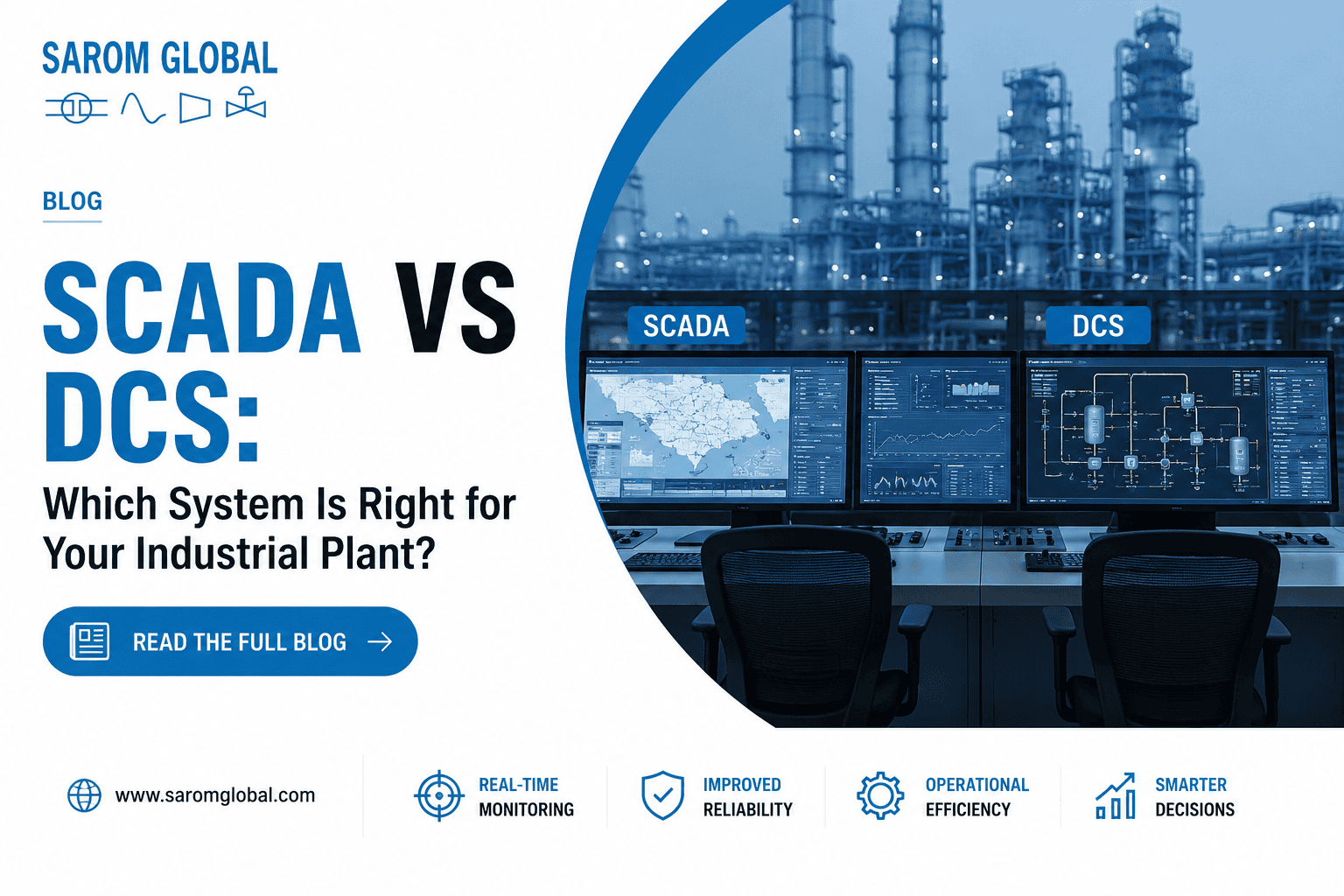
Short Answer: SCADA and DCS serve different purposes. SCADA is best for monitoring and controlling assets spread across multiple locations, while DCS is designed for continuous, high-speed control within a single plant. Many industrial facilities use both systems together to get the benefits of centralised monitoring and precise process control.
Choosing between SCADA and DCS is a big decision. It shapes how a plant runs for the next 15 to 20 years. Australian industries in mining, LNG, water, power and manufacturing are going digital fast. That makes this choice matter more than ever.
Here’s the short answer. SCADA vs DCS isn’t really a contest. SCADA watches over assets spread across a wide area. A DCS runs tight, ongoing control loops inside one plant. Each one solves a different problem. Many plants end up using both. This guide shows how each system works. It shows where each one fits best. It also shows how to pick the right one for your site.
Is This Guide for You?
This guide is for you if you:
- Need to decide between SCADA and DCS for a new project or plant upgrade.
- Work in mining, water, oil & gas, LNG, power, manufacturing, or utilities.
- Want to understand which system offers the best performance, scalability, and long-term value.
- Are planning a digitalisation project or control system migration.
- Need a clear explanation of how SCADA, DCS, and PLCs work together in modern industrial automation.
SCADA vs DCS: Key Differences at a Glance
The core difference is simple. SCADA watches over wide, spread-out sites. A DCS controls deep, local work in one plant. Cost, setup and vendor choice all flow from that one split.
| Feature | SCADA | DCS |
|---|---|---|
| Main job | Watches and controls spread-out assets. | Runs one linked, ongoing process. |
| Setup | Central server with remote units over IP, radio, or serial links. | Linked controllers in one shared setup. |
| Control style | Reacts to events; a person often steps in. | Runs on its own, fast and steady. |
| Reach | Wide area, many sites. | One plant or one tight site. |
| Speed | Often seconds. | Often milliseconds. |
| Growth | Easy to add new sites. | Can grow, but needs more design work. |
| Vendors | Often open, many brands. | Often one main brand. |
| Cost | Lower to start; grows with each new site. | Higher to start, due to backup gear. |
| Best fit | Water, mining, pipelines, power lines. | LNG, refineries, power plants. |
| Main users | Teams watching spread-out sites. | Engineers running one plant. |
Plant managers notice one thing first: timing and distance. If your equipment is located across multiple sites, SCADA is often the ideal system for centralised monitoring and control. In environments where precise control, fast operation, and safety are essential, a DCS often delivers the best long-term performance and reliability.
What Is SCADA?
SCADA (Supervisory Control and Data Acquisition) is a technology that helps industries monitor, control, and collect data from industrial processes in real time. It’s a software system. It watches gear spread across sites that may sit far apart. It pulls live data from PLCs and RTUs in the field. It then gives staff one screen to view, alarm on, and control that gear.
Think of SCADA as eyes and ears over a wide patch of land. It usually doesn’t run fast, split-second loops itself. That job often sits with PLCs or RTUs at each site. SCADA pulls the data together. It shows the data on a screen called an HMI. It stores the data in a log called a historian. Staff can then step in when something needs care.
A typical SCADA setup has:
- RTUs and PLCs at each site. They collect data and run local logic.
- Networks that link sites back to one server. These can be IP, radio, satellite, or mobile links.
- Screens where staff view live status and trends.
- A historian that stores data for later use.
- Alarm tools that flag odd readings.
SCADA reacts to events. It doesn’t run on a fixed, split-second clock. Speed is often measured in seconds, not fractions of a second. That’s fine for most jobs. SCADA isn’t built to catch a split-second fault. It’s built to give a clear view of gear spread over kilometres.
In Australia, SCADA shows up in a few places. Water plants use it to manage sites spread across a region. Mining firms use it to watch haulage and pipe networks. Power grids use it to watch substations and feeders. Remote gas fields use it where wells sit far from any control room.
Takeaway:
SCADA is the right tool when you need one clear view over gear spread across a wide area.
What Is a Distributed Control System (DCS)?
A DCS is a linked control system. It runs many ongoing, closed-loop tasks in one plant.Unlike SCADA, a DCS offers continuous, real-time control, making it ideal for industrial processes that require high accuracy, reliability, and fast response. It manages flow, heat, pressure and level in real time.
In plain terms, a DCS runs the process. It doesn’t just watch it. Its controllers sit close to the gear they run. But they all share one design, one log and one screen. This differs from SCADA’s looser, often mixed-brand setup.
Key parts of a DCS often include:
- Controllers placed near the gear they run, working as one system.
- Closed-loop control. The system keeps adjusting on its own.
- Strong backup power and spare parts to avoid downtime.
- One shared design tool, screen and log, often from one brand.
- Built-in alarm and tuning tools.
A fault in a nonstop plant can cause real harm. It can hurt safety, the site, or the budget. That’s why a DCS is built for steady uptime and fast response. This is why it’s the top pick for large, safety-critical plants that run nonstop.
In Australia, a DCS often runs LNG plants, refineries, power plants, chemical sites and large ore sites. These sites often link thousands of points that must work as one.
SCADA vs DCS vs PLC
A PLC is a fast, local brain. It runs one machine or one process cell. It’s often a part inside both SCADA and DCS. It’s not a swap for either.
PLCs suit fast, repeat tasks. Think packing lines, belts, pumps, or one machine. On its own, a PLC can run a task with no system above it. In bigger setups, PLCs often sit under SCADA. They run fast, local logic. SCADA watches many PLCs across a wide network. SCADA also adds alarms, trends and a remote view. In a DCS, the linked controllers do a similar job. But they work as one plant-wide system.
The link often looks like this: a PLC runs one machine. SCADA watches a wide area. A DCS runs deep control of one nonstop process. Our PLC vs DCS guide covers this in more depth.
When Should You Choose SCADA?
SCADA often fits when your gear is spread across a wide area. Your goal is a clear view, not split-second control. It suits setups where many sites report back to one room.
Pick SCADA when:
- Assets sit far apart, across a region or state.
- You run many sites with mixed gear types.
- The job is a utility network, like water or power lines.
- Pipes or wells need one central view.
- Mine sites span wide land with scattered pumps, belts, or haul roads.
- Budget and staged growth matter more than one full system.
- You want to mix brands and swap parts over time.
Here’s an Aussie example. A water authority runs plants, tanks and pumps across many towns. SCADA lets one room watch water levels, dosing and pump status everywhere. Alarms fire on their own if a pump fails or a tank runs low. Staff don’t need to visit the site to know something’s wrong.
When Should You Choose a DCS?
A DCS often fits a nonstop job with many linked parts. Steady, high-uptime control matters here for safety and quality. This suits one tight site, not a spread-out network.
Pick a DCS when:
- The job runs nonstop, not in batches.
- High uptime and backup power are a must.
- The plant has many linked points that must work in real time.
- Loops affect each other in complex ways.
- A slow response could cause a serious fault.
LNG sites, refineries and power plants are common cases. Each runs many linked units that must work as one. In these settings, the backup power built into a DCS often earns back its higher upfront cost.
Can SCADA and DCS Work Together?
Yes. Most large sites now run a mix of both. SCADA, DCS and PLCs each take the job they suit best.
A common mix looks like this:
- PLC layer: fast, local control of one machine or cell.
- DCS layer: steady, ongoing control of the core process.
- SCADA layer: a wide view across the site, plus support gear.
- Cloud layer: dashboards and upkeep alerts built on top of both.
Modern plants link these layers with open tools, like MQTT and OPC UA. This sends data from the DCS or SCADA layer up to the cloud. It does this without touching the gear below. This helps IT and plant teams work as one. It also aids upkeep and digital plans, with no full system swap needed.
Here’s an example. An LNG site may run its main process on a DCS. SCADA then watches the site’s utilities, tanks and remote gauges. Both feed one shared log. That gives staff one full view of how the plant runs.
How to Choose the Right Control System
Three things drive your choice: how spread out your assets are, how fast your control must be, and where the plant is headed. Work through these questions first:
- Are your assets spread out, or in one site?
- Does your job run nonstop, or in batches?
- How fast must control react to stay safe?
- Do you want to mix brands, or use one full system?
- How much backup power do you need?
- Will the plant grow a lot in the next 5 to 10 years?
- Do you have digital plans the setup must support?
- What safety rules apply to remote access and networks?
- What’s your long-term upkeep plan, and who supports it?
Every plant has its own needs. Your answers will point you toward SCADA, DCS, or a mix of both.
How Sarom Global Helps Industrial Plants Optimise Control Systems
Choosing between SCADA and DCS is rarely simple. It touches process design, gear, safety, network security and long-term upkeep. That’s why many plants bring in outside engineers before they commit.
Sarom Global works with plant owners across energy, utilities, oil and gas. We act as your Owner’s Engineer, backing your interests through design, buying and start-up. Our Process Engineering team helps pick the setup that fits your needs. Our Instrumentation & Control team then handles the detailed design and build work.
We also help with alarm management reviews and plant digitalisation work, including our own POSy-System. We run FAT and SAT tests to check gear works as planned. If something goes wrong, our team can trace the fault back to its root cause.
Conclusion
There’s no single winner in SCADA vs DCS. They solve different jobs. SCADA gives you one clear view of spread-out gear. A DCS gives you deep, steady control of one nonstop process. Many plants end up needing both, with PLCs at the base.
The right setup depends on your process type, site layout, safety needs and long-term goals. Bringing in expert help early often saves cost and rework down the track.
Planning a control system upgrade, or a new site build? Sarom Global can help. We offer expert guidance on system choice, migration, and tuning. Call +61 2 8317 5089 or email info@saromglobal.com to talk about your project.