

Put simply, it is the difference between a control room where alarms mean something and one where operators have learned to tune them out.
A well-run alarm management system reduces nuisance alarms, prevents alarm floods, and helps operators respond to genuine plant threats before they escalate. It is a core requirement for any Australian facility operating under ISA-18.2, WHS (Work Health and Safety) legislation, or NOPSEMA safety frameworks
Quick Answer: What Is DCS Alarm Management?
DCS alarm management is a structured process used to design, prioritise, and continuously improve alarm systems within a Distributed Control System (DCS). The goal is straightforward: make sure operators receive the right alarms, at the right time, with enough context to act safely and quickly.
Who This Guide Is For
This guide is written for people who work directly with industrial control systems and process plants:
- Plant operators dealing with alarm overload on shift who want to understand how to fix it
- Control and instrumentation engineers responsible for configuring or maintaining a DCS
- Process engineers involved in alarm philosophy development or rationalisation projects
- Plant managers and HSE leads looking to assess alarm system performance and regulatory compliance
Whether you work in oil and gas, LNG, mining, chemical processing, or utilities across Australia, the principles here apply directly to your plant.
What Is DCS Alarm Management and Why Does It Matter?
Every process plant depends on information. When temperatures rise beyond safe limits, when flow rates drop unexpectedly, or when equipment starts to fail, the DCS fires an alarm to alert the operator so they can act.
That is the theory. The reality is often quite different.
Modern DCS platforms make it almost effortless to configure alarms. There is no physical cost to adding one more. As a result, plants that started with a handful of meaningful alarms end up with thousands — many of them redundant, poorly timed, or triggered by conditions that require no action at all.
DCS alarm management is the discipline that fixes this. It covers everything from writing the initial alarm philosophy through to ongoing monitoring, rationalisation, and auditing. Every alarm in a well-managed system has a clear purpose. Every operator knows what to do when it triggers. Critical warnings never disappear into background noise.
For plant operators across Australia’s oil and gas, LNG, mining, and chemical processing sectors, this is not optional. It is a direct contributor to process safety, regulatory compliance, and operational uptime.
Our process control and plant optimisation services support plants at every stage of this journey, from first-time alarm philosophy development through to full-scale rationalisation projects.
Direct Answer: DCS alarm management is a structured process used to design, prioritise, and optimise industrial control system alarms to improve operator response and plant safety.
The Real Cost of Poor Alarm Management
Poor alarm management carries a measurable cost — in lost production, near-misses, and in some cases, serious industrial incidents.
What an Alarm Flood in DCS Looks Like in Practice
Picture an operator on shift during an abnormal process condition. Pressures are climbing. Temperatures are swinging. The DCS starts flooding the screen with alerts — 50, 100, 200 alarms in the space of a few minutes. Some are critical. Most are not. But the sheer volume makes it almost impossible to separate the two.
This is called an alarm flood in DCS, and it is one of the most dangerous situations a control room operator can face. Industry research shows that alarm floods have been directly linked to major industrial accidents where operators simply could not identify the root cause fast enough to prevent escalation.
The Numbers Behind the Problem
| Alarm Rate | EEMUA 191 Assessment |
|---|---|
| Up to 150 alarms per day (1 per 10 min) | Very likely acceptable |
| 300 alarms per day (1 per 5 min) | Manageable but demanding |
| Over 300 alarms per day | Likely overloaded |
| More than 10 alarms per minute | Alarm flood — serious operational risk |
Most plants without a structured alarm management system far exceed these thresholds. Industry data shows peak daily alarm rates in unmanaged facilities can reach tens of thousands per day. No operator can work safely or effectively in those conditions.
Is your plant already experiencing alarm overload?
The Hidden Costs
Beyond the immediate safety risk, poor alarm management in industrial control systems creates a chain of compounding problems:
- Operator fatigue: When alarms fire constantly, operators become desensitised. They start ignoring alerts — not out of laziness but out of self-preservation. This condition is known as alarm fatigue, and it poses a serious risk.
- Nuisance alarms: Alarms that trigger repeatedly without needing any action erode trust in the entire system. When every third alarm is a nuisance, operators stop trusting the ones that matter.
- Missed critical alarms: In a high-noise environment, genuinely urgent warnings get acknowledged and dismissed without proper attention.
- Production loss: Even minor alarm floods can force operators to cut plant throughput as a precaution, directly affecting output and revenue.
- Regulatory risk: Australian facilities that cannot demonstrate a structured approach to control room alarm management face scrutiny under WHS legislation and NOPSEMA requirements.
The financial and human cost of getting this wrong is real. The good news is that it is entirely fixable with the right alarm management system and approach.
Key Standards in DCS Alarm Management
Before looking at how to fix an alarm system, it helps to understand the frameworks that define what good looks like. There are three standards every Australian plant operator and engineer should know.
ISA-18.2 (ANSI/ISA-18.2)
What it is: The primary global standard for alarm management in process industries. Developed by the International Society of Automation (ISA) and first published in 2009.
What it defines: A complete alarm management lifecycle covering everything from alarm philosophy development through to ongoing audit and performance review.
Why it matters: ISA-18.2 provides the industry benchmark for alarm prioritisation, rationalisation, and performance monitoring. It is the foundation for alarm management consulting work across Australia and internationally. If you are reviewing your DCS engineering services or planning a system upgrade, ISA-18.2 compliance should be built in from the start.
IEC 62682
What it is: The international version of ISA-18.2, published by the International Electrotechnical Commission (IEC). The two standards are substantially aligned.
Why it matters: Plants working with international contractors or operating across multiple jurisdictions will often reference IEC 62682 alongside ISA-18.2. Demonstrating compliance with both supports stronger governance documentation.
EEMUA 191
What it is: A guidance document published by the Engineering Equipment and Materials Users Association (EEMUA), widely used in the UK, Australia, and internationally.
Why it matters: EEMUA 191 contains practical, operator-level guidance on alarm system design and the performance benchmarks used throughout this guide — including the widely referenced alarm rate targets.
Together, these three standards give Australian plant operators a clear, defensible framework for alarm system governance that aligns with WHS obligations and NOPSEMA requirements.
What the ISA-18.2 Alarm Management Guide Says
ISA-18.2 defines alarm management as a lifecycle — not a one-time configuration exercise. It requires ongoing attention, monitoring, and improvement at every stage of a plant’s operation.
Core Principles of ISA-18.2
- Every alarm must be justified. An alarm should only exist if it requires operator action and if that action cannot wait. If an alarm fires and the operator has nothing useful to do in response, it should not be an alarm.
- Priority must reflect reality. ISA-18.2 recommends that only around 5% of configured alarms sit at the highest priority level. Industry surveys consistently show that unmanaged plants average around 28% high-priority alarms — a figure that completely devalues the priority system and leaves operators unable to quickly identify what truly needs immediate attention.
- Alarm management is never finished. The standard describes a multi-stage lifecycle that includes ongoing monitoring, performance assessment, change management, and periodic auditing. Plants that treat it as a one-off project always regress.
- Operators must be involved. The people who work the control room every day know which alarms are useful and which are noise. Any alarm philosophy developed without operator input is unlikely to survive contact with real plant conditions.
For plants in Queensland and across Australia, alignment with ISA-18.2 also supports compliance with Safe Work Australia frameworks — something that carries real weight in regulatory audits and incident investigations.
The DCS Alarm Management Lifecycle: Step by Step
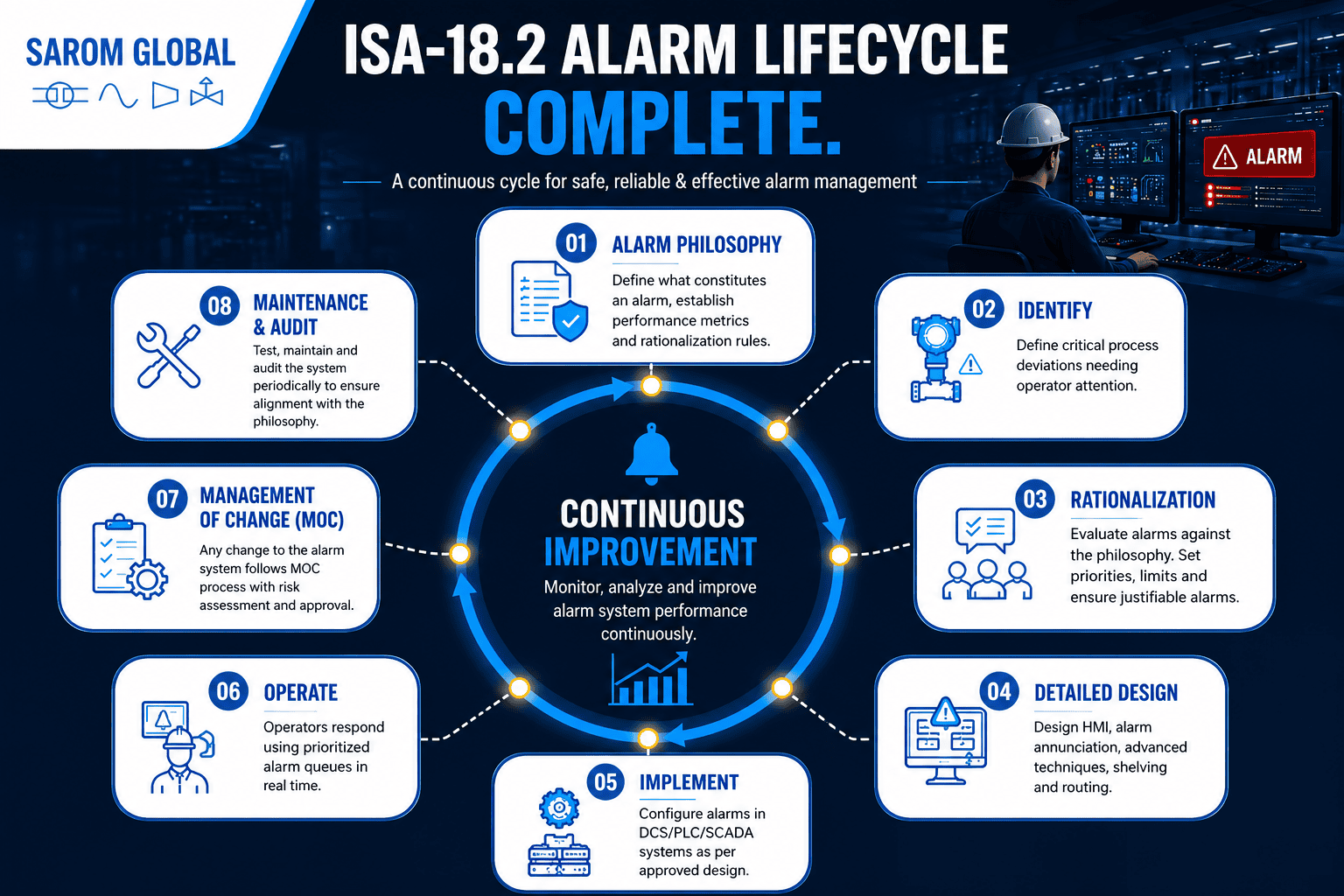
ISA-18.2 defines alarm management as a seven-stage lifecycle. Here is what each stage involves and why it matters.
Step 1: Alarm Philosophy Development
The alarm philosophy document is the foundation of everything that follows. It defines the rules that govern how alarms are configured, prioritised, suppressed, and maintained across the plant.
A solid alarm philosophy covers:
- What qualifies as an alarm and what does not
- How alarms are assigned priority levels
- Rules for suppressing alarms during startup, shutdown, or other known operating states
- Roles and responsibilities for alarm management
- Management of Change (MOC) procedures for future alarm modifications
This document must be built with input from control room operators, process engineers, and technical supervisors. An alarm philosophy written without involving the people who use the system will not last long in practice.
Step 2: Alarm Rationalisation in DCS Systems
Alarm rationalisation is the process of reviewing every existing alarm and asking one question: does this alarm need to exist?
Each alarm is assessed against the philosophy. Redundant alarms are removed. Poorly configured process control alarms are corrected. Setpoints are validated against actual process risk. For every alarm that survives the review, a documented response procedure is written so operators know exactly what action is required.
A comprehensive rationalisation can lead to substantial outcomes. Documented case studies from process plants show alarm generation dropping by over 90% after a structured programme — with no reduction in safety coverage.
Step 3: Alarm Prioritisation
Not every alarm is equally important. A structured priority scheme ensures that when multiple industrial alarm systems fire at the same time, operators can quickly triage and respond to the most critical conditions first.
| Priority | Description | Response Time |
|---|---|---|
| Safety-Critical (PX) | Safety systems and hardwired interlocks | Immediate |
| Process Stop Risk (P1) | Conditions that may lead to a process shutdown | Under 3 minutes |
| Equipment Failure (P2) | Equipment failure or abnormal conditions affecting the process | Under 15 minutes |
| Equipment Warning (P3) | Early warning of conditions that may escalate | Under 30 minutes |
| Event (Log Only) | Logged events requiring no immediate action | N/A |
The key principle: if everything is urgent, nothing is. High-priority alarms must be rare to carry weight.
Step 4: Design and Implementation
Once the philosophy and rationalisation work is complete, alarm configurations are built into the DCS. This includes setting alarm setpoints and deadbands, configuring suppression logic for different operating states, and designing the Human-Machine Interface (HMI) to present alarm information clearly.
Good HMI alarm design uses consistent colour-coding aligned to priority levels, logical grouping of related alarms, and response guidance accessible directly from the alarm screen. Operators should not need to consult a separate document while a high-priority alarm is active.
Our HMI design and control room optimisation services can help you assess whether your current alarm presentation supports or hinders fast operator decision-making.
Step 5: Monitoring and Performance Assessment
Alarm management does not stop at implementation. Ongoing tracking of key performance indicators (KPIs) is essential to catch problems before they become serious.
Critical metrics to monitor:
- Average and peak alarm rates benchmarked against EEMUA 191 guidelines
- Chattering alarms that rapidly toggle between active and inactive
- Stale or standing alarms that remain active for extended periods
- Alarm flood frequency in control systems
- Bad actor alarms — the small group responsible for a disproportionate share of total alarm count
Step 6: Management of Change
Any change to an alarm configuration must follow a formal Management of Change (MOC) process. This means documenting the proposed change, getting appropriate approval, notifying operators, and checking alignment with the alarm philosophy.
Without this, ad hoc point changes accumulate quietly over months and years. The result is a system that no longer reflects its own philosophy — and an alarm environment that operators have learned to distrust.
Step 7: Continuous Improvement and Audit
Regular reviews ensure the alarm system operates as expected while helping the organisation stay compliant with ISA-18.2, EEMUA 191, and IEC 62682.
Plants that treat alarm management as a one-off project typically find themselves back where they started within two or three years. The lifecycle never ends — it just gets easier to maintain once it is properly set up.
Alarm Management vs Alarm Rationalisation: What Is the Difference?
This is one of the most common points of confusion for engineers new to the topic. Here is a simple breakdown.
| Alarm Management | Alarm Rationalisation | |
|---|---|---|
| What it is | The full, ongoing programme for managing an alarm system across its entire lifecycle | A specific activity where each alarm is reviewed, validated, and documented against the agreed philosophy |
| Scope | Covers philosophy, design, implementation, monitoring, change management, and audit | Focuses on reviewing existing alarms against the philosophy |
| Timing | Continuous — never truly finished | A defined project with a start and end, repeated periodically |
| Output | A governed, well-performing alarm system | A cleaned-up alarm database with documented rationale for every alarm |
| Standard | ISA-18.2 lifecycle | A core step within ISA-18.2 |
In short: alarm management is the full programme. Alarm rationalisation is one of its most important steps — and often the one that delivers the fastest visible improvement.
What Alarm Rationalisation Actually Delivers
Numbers help here. Based on documented case studies from process plants that completed a structured alarm rationalisation programme:
| Metric | Before Rationalisation | After Rationalisation |
|---|---|---|
| Total alarms generated | Baseline (100%) | Reduced by up to 93% |
| Alarms presented to operators | High and unmanageable | Reduced by up to 88% |
| Chattering alarm occurrences | Frequent | Reduced by 65% |
| Total configured alarms | Thousands of undocumented entries | Reduced by approximately 50% |
| Safety coverage | — | Maintained and improved |
Safety coverage did not decrease. In fact, it improved — because operators could now actually see and respond to the alarms that mattered rather than spending their shift managing noise.
In Australian oil and gas and LNG facilities, where control room operators oversee complex and interconnected processes, such outcomes directly lead to improved safety performance, reduced operator workload, and fewer disruptions to production.
Learn more about how our alarm rationalisation and management services deliver results like this for Australian plants.
Common DCS Alarm Management Mistakes
Even plants that have invested in a DCS alarm management programme can fall into traps that quietly undermine the work. Here are the most common mistakes — and what they look like in practice.
- Treating rationalisation as a one-off project Alarm rationalisation is not a box to tick and move on from. Without a formal Management of Change process and ongoing monitoring, alarm counts creep back up over time. Plants that do not schedule periodic reviews almost always regress.
- Configuring alarms without operator input Engineers often configure alarms based on process parameters alone, without asking control room staff which conditions actually require action. The result is an alarm philosophy that looks correct on paper but generates alarm fatigue on shift.
- Setting too many high-priority alarms When everything is high priority, nothing is. Many plants assign critical or high status to alarms as a precaution — but this devalues the priority scheme entirely. ISA-18.2 recommends that high-priority alarms make up no more than 5% of the total count.
- Ignoring chattering alarms Chattering alarms — those that rapidly toggle between active and inactive — are one of the biggest contributors to operator desensitisation. A single chattering alarm can generate thousands of alerts per shift and train operators to ignore the entire alarm system. They need to be identified and fixed, not bypassed.
- Failure to enforce Management of Change. This is one of the most common ways even a well-designed alarm management system can break down. Without a formal MOC process, individual engineers or operators make point changes to alarm configurations without considering the system-wide impact. Over time, the alarm philosophy becomes meaningless because the system no longer follows it.
- No performance monitoring after implementation Implementing an alarm management system without ongoing KPI monitoring is like servicing a car and never checking the oil again. Alarm performance degrades without regular assessment. Bad actors reappear. New nuisance alarms emerge. Monitoring is essential—it is an integral part of the ISA-18.2 lifecycle for a reason.
- Suppressing alarms without tracking them Suppressing a nuisance alarm feels like a quick fix. But if suppressed alarms are not tracked, reviewed, and either fixed or formally accepted, they create a false sense of security. In one documented European refinery case, 83% of generated alarms were suppressed — leaving operators with no visibility of real process risk.
Best Practices for Alarm Rationalisation Projects
If you are planning an alarm rationalisation for your DCS, the following practices will help you get the most from the exercise and make the results last.
Start with the alarm philosophy, not the alarms Before reviewing a single alarm, make sure you have an agreed, documented alarm philosophy. Rationalising alarms without a philosophy is like editing a document without knowing what the document is supposed to say.
Involve operators from day one Control room operators are the single most valuable resource in any rationalisation project. They know which alarms have always been noise and which ones they genuinely rely on. Run structured workshops and treat operator feedback as data, not opinion.
Tackle bad actors first In most unmanaged plants, a small number of alarms — typically 5 to 10% — generate the majority of the total alarm volume. Identifying and resolving these bad actors delivers the fastest improvement in operator workload and can be done in the early stages of a project.
Document everything For every alarm that survives the rationalisation process, document the justification, the setpoint rationale, the response procedure, and the priority assignment. This documentation is what prevents the system from degrading again over time.
Set realistic KPI targets before you start Define what success looks like in measurable terms — a target average alarm rate, a maximum percentage of high-priority alarms, a target chattering alarm count. This gives the project clear goals and makes it easier to demonstrate results after completion.
Plan for ongoing governance before you finish Decide how alarms will be managed after the project ends before it ends. Assign responsibilities. Set a schedule for periodic reviews. Define the MOC process for future alarm changes. A rationalisation project with no governance plan will need to be repeated sooner than it should.
Align with ISA-18.2 from the start Structure the project around the ISA-18.2 lifecycle. This ensures your documentation and process are audit-ready and that nothing important is missed.
Our process engineering consulting team can guide your project from initial assessment to post-implementation governance. Contact us to discuss your plant’s specific situation.
Signs Your Plant Needs Alarm Rationalisation
If any of the following apply to your facility, it is time to look seriously at your alarm management system.
- Operators receive more than 30 alarms per hour during normal operations
- The same alarms appear repeatedly without any action being needed
- Operators acknowledge alarms without reading them because there are simply too many
- Alarm floods are a regular feature during plant upsets, startups, or shutdowns
- There is no documented alarm philosophy for the plant
- Alarm priorities have not been reviewed since the DCS was originally commissioned
- High-priority alarms make up more than 10 to 15% of the total alarm count
- Operators describe the industrial alarm system as unreliable or not useful
- There is no regular reporting on alarm system performance KPIs
- Alarm configurations have been changed without a formal change process
If three or more of these apply, you are not alone. Most plants that have never been through a formal alarm rationalisation process will recognise several items on that list.
How Sarom Global Approaches DCS Alarm Management Projects
Sarom Global is an Australian-based, multi-disciplined industrial engineering consultancy with practical experience across the energy, utilities, oil and gas, and process industries. Their approach to DCS alarm management is grounded in the ISA-18.2 lifecycle and built around what actually works in the control room.
Alarm Philosophy Development
Every engagement begins with the fundamentals. Sarom Global works with plant operators, process engineers, and technical supervisors to develop a site-specific alarm philosophy document. This is not a template exercise — it reflects the actual operating conditions, process risks, and control room culture of each plant.
Alarm Rationalisation Workshops
Sarom Global facilitates structured alarm rationalisation workshops that bring together the people who know the plant best. Each alarm is assessed, justified, or removed. Response procedures are documented. Priority assignments are validated against the philosophy.
The result is a streamlined alarm database that operators rely on and that remains effective under pressure. Learn more about our alarm rationalisation service.
ISA-18.2 Compliance
All Sarom Global alarm management projects are aligned with ANSI/ISA-18.2 and the IEC 62682 framework. For Australian plants operating under WHS requirements or subject to NOPSEMA oversight, this provides a documented, auditable basis for alarm system governance.
Control Room Optimisation and HMI Design
Alarm management does not exist in isolation from the control room. Sarom Global supports HMI design review and control room optimisation, making sure alarm information is presented in a way that supports fast, accurate decision-making when things go wrong.
DCS Alarm Management Training
Good control room alarm management is only as effective as the people who use and maintain it. Sarom Global offers specialist training programmes including:
- DCS Alarm Management — alarm philosophy, rationalisation process, performance monitoring, and ISA-18.2 compliance
- Practical Process Control and Advanced Practical Process Control — broader control system capability for operations and engineering teams
View our full training programme catalogue for dates and enrolment details.
Plant Digitalisation and the POSy-System
For plants looking to go further, Sarom Global’s plant digitalisation capability and the POSy-System provide a pathway to smarter, data-driven plant optimisation — including better integration of alarm performance data with broader process monitoring.
Contact the team directly to discuss your situation:
Email: info@saromglobal.com Phone: +61 2 8317 5089