
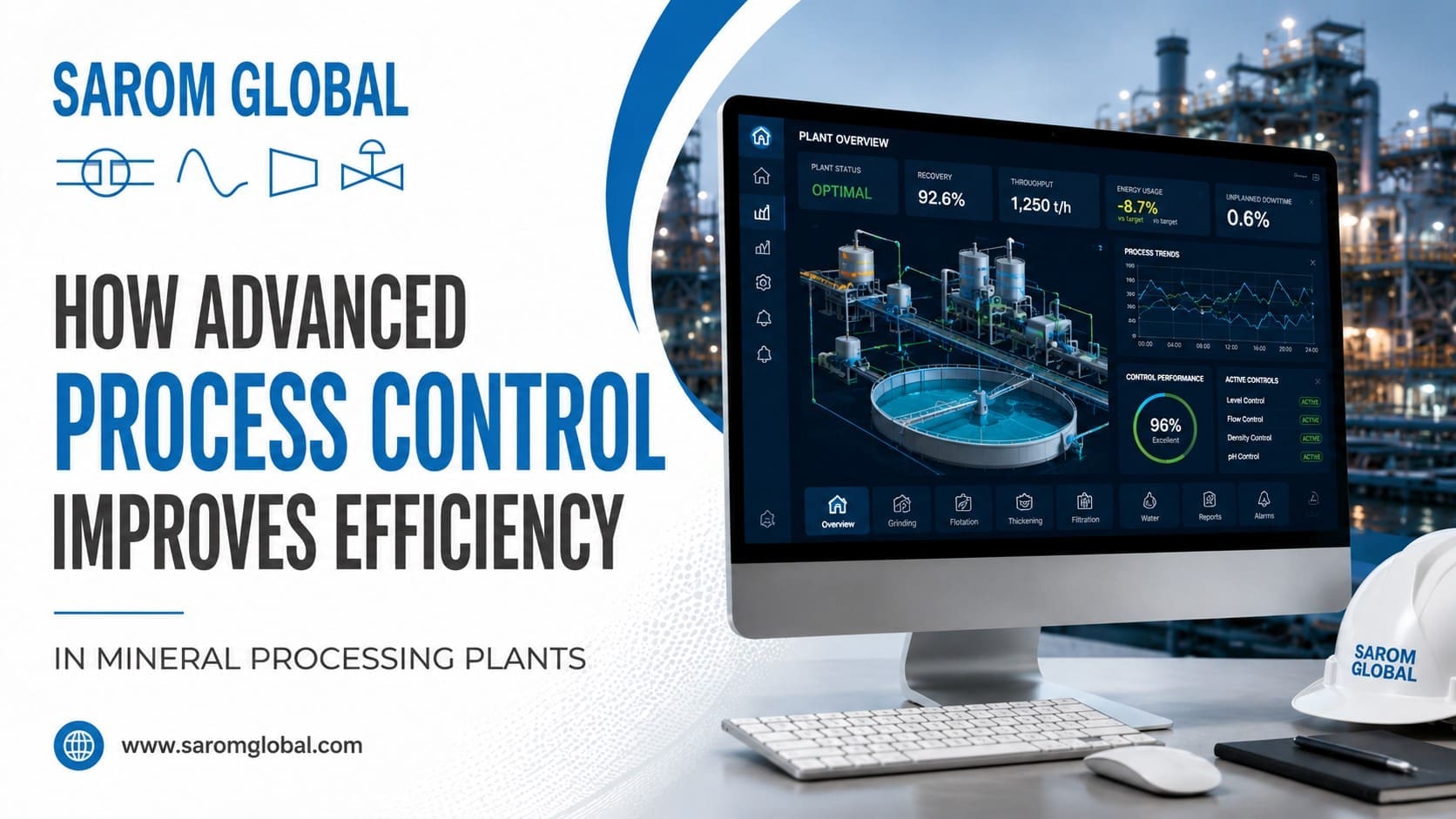
How Advanced Process Control Improves Efficiency in Mineral Processing Plants
Mineral processing plants deal with constant change. Ore grades shift. Equipment wears down. Feed conditions vary from one hour to the next. These changes put enormous pressure on plant operators — and on the control systems that keep operations running smoothly.
Traditional plant control systems, built around basic PID (Proportional-Integral-Derivative) loops, were designed for simpler processes. They can hold a single variable steady, but they struggle when multiple variables interact at the same time. In a grinding circuit, for example, changing the feed rate affects mill load, power draw, and water balance all at once. A basic PID controller cannot manage that level of complexity.
This is where Advanced Process Control (APC) makes a real difference. APC uses predictive, multi-variable algorithms to manage complex processes in real time. It stabilises plant performance, reduces energy waste, and helps operators maintain consistent output — even as conditions change.
In this article, we explore what Advanced Process Control is, how it works, and why it has become essential for modern mineral processing plants.
What Is Advanced Process Control?
Advanced Process Control (APC) is a predictive automation technology that optimises multiple process variables in real time to improve plant stability, energy efficiency, and operational performance. It sits above traditional PID loops and is widely used in mineral processing, mining, and heavy industry.
APC is a layer of automation technology that sits above traditional PID control loops. It uses mathematical models and predictive algorithms to monitor multiple process variables simultaneously and make real-time adjustments to keep a plant running at its best.
Unlike basic control systems that react to changes after they occur, APC anticipates them. It looks ahead, predicts how a process will behave, and acts early — before instability can affect production.
APC applies across grinding circuits, flotation cells, thickeners, and many other stages of the processing flowsheet. When implemented correctly with the support of experienced process control system consultants, it moves a plant from reactive operations to proactive, optimised control.
Why Traditional PID Loops Struggle in Mineral Processing
PID controllers work well in simple, isolated control loops. But mineral processing is rarely simple.
In most plants, variables like feed grade, particle size, water content, and equipment wear are constantly changing. These variables do not operate in isolation — they influence each other. When one changes, several others follow. A basic PID controller can only manage one variable at a time and cannot account for these interactions.
The result is oscillation. Loops fight each other. Operators are forced to intervene manually, increasing workload and the risk of error. Process instability leads to lower recovery, wasted energy, and inconsistent product quality.
The table below illustrates how APC differs from traditional PID control in practice:
How APC Works in Modern Processing Plants
APC works by collecting data from sensors and instruments across the plant in real time. It feeds this data into dynamic process models — mathematical representations of how a specific process behaves under different conditions.
Using these models, the APC system predicts what will happen next and calculates the best control actions to take right now. It coordinates multiple control loops simultaneously, balancing competing demands and keeping the process stable within defined targets.
The result is smoother, more consistent plant operation — with less manual intervention and better performance across all key metrics. This shift from reactive plant control systems to proactive automated control systems is what defines the APC advantage in modern mineral processing.
The Main Layers of Advanced Process Control
Modern APC is a tiered system. Advanced Regulatory Control (ARC) forms the foundation. Model Predictive Control (MPC) coordinates multiple loops simultaneously. AI and machine learning add adaptability, updating models within physical mass balance constraints as process conditions change.
Modern APC is not a single tool. It is a tiered system of technologies that sit on top of one another, each building on the layer below.
Advanced Regulatory Control (ARC)
ARC is the foundation of any APC system. It enhances standard PID loops with more sophisticated techniques to help them recover faster from process disturbances.
Key ARC techniques include:
- Feed-forward control — anticipates disturbances before they affect the process
- Cascade control — uses an outer loop to set the target for an inner loop, improving stability
- Override logic — automatically switches between control strategies when process limits are reached
ARC improves base-level stability and provides a reliable platform for the more advanced layers above it. It is typically the first step in any instrumentation and control automation upgrade programme.
Model Predictive Control (MPC)
Model Predictive Control (MPC) uses dynamic mathematical models to predict future process behaviour and calculate optimal control actions across multiple loops simultaneously. It is the core technology in most APC implementations for advanced process control in mineral processing plants.
MPC is the core technology in most APC implementations. It is a major step forward from basic PID control.
MPC uses dynamic process models to predict how a process will behave over the next few minutes or hours. Based on these predictions, it calculates the optimal control actions across multiple loops simultaneously — balancing competing objectives and respecting process constraints.
In practice, in a grinding circuit, MPC manages the relationship between mill feed rate, water addition, and mill load at the same time. Rather than tuning each loop independently, MPC coordinates all three to maintain stable, efficient operation — while keeping the product particle size (P80) within the target range required for effective downstream flotation.
This multi-variable coordination is what makes MPC so powerful in mineral processing, where processes are naturally complex and interconnected.
AI, Machine Learning, and the Case for Hybrid Phenomenological Modelling
The newest layer of APC technology uses artificial intelligence (AI) and machine learning to make MPC models adaptive. Over time, process conditions change — ore characteristics shift, equipment ages, and seasonal factors affect water and energy availability.
However, purely data-driven AI models carry a significant risk in mineral processing. If a model adapts to a temporarily skewed dataset — caused by a weathered ore pocket, a slime-rich feed event, or an extreme Bond Ball Mill Work Index (BWi) variation — it can generate setpoints that are mathematically logical but metallurgically disastrous.
The industry best practice is Hybrid Phenomenological Modelling. In this approach, AI and machine learning are constrained by fundamental mineral physics — including mass balances, empirical grinding laws such as Bond’s Law, and circuit-specific residence times. The control layer can adapt and learn, but it can never violate physical reality.
This distinction matters enormously to plant metallurgists and process engineers. AI in APC should augment engineering judgment — not replace it.
How APC Improves Mineral Processing Performance
The impact of Advanced Process Control is felt across every stage of the processing flowsheet. Here are three areas where the improvements are most significant.
Grinding Circuit Optimisation
Grinding is typically the most energy-intensive stage in mineral processing, consuming up to 10 kWh per tonne of ore. Even small efficiency gains here have a large impact on operating costs.
The true measure of grinding circuit performance is not simply throughput — it is maximising dry tonnage while strictly maintaining the target product particle size, expressed as P80 (the particle size at which 80 percent of the material passes through a given screen). If the P80 drifts coarse, downstream flotation recovery suffers. If it goes too fine, energy is wasted and overgrinding can depress flotation performance for certain minerals.
APC manages this trade-off in real time. It uses ore hardness characterisation data — including the Bond Ball Mill Work Index (Bwi) and SAG-specific SMC parameters — to anticipate how a change in feed will affect grind and adjust mill speed, feed rate, and water addition proactively. Online Particle Size Analysers (PSI) in the cyclone overflow provide continuous P80 feedback directly into these mill feed-rate loops, closing the circuit around the actual metallurgical output rather than a surrogate variable.
Shell-mounted vibration sensors and acoustic arrays map internal liner impacts in real time, detecting under-fill and over-fill conditions that risk catastrophic ball-on-liner damage during low-feed scenarios. APC acts on this data immediately, protecting liner life and reducing unplanned downtime.
Industry data shows these approaches deliver productivity gains of 3 to 6 percent — and at sites implementing load-based speed control, standard deviation in mill load has been reduced by up to 79 percent.
Flotation Process Stability
Flotation control is one of the most metallurgically demanding challenges in mineral processing. The fundamental objective is not simply stability — it is navigating the Recovery vs. Grade trade-off curve. Pushing recovery too hard sacrifices concentrate grade. Protecting grade too aggressively leaves recoverable metal in the tailings.
APC manages this trade-off across the entire flotation circuit. At the cell level, it controls the pull-rate of individual cells, balancing air-flow rates against froth depth. The Jg factor — the superficial gas velocity through the froth — is a key variable that APC adjusts dynamically to maintain optimal bubble loading and froth stability.
Reagent dosing is equally critical. Online X-ray Fluorescence (XRF) analysers provide real-time elemental assay data from the pulp, allowing APC to dynamically adjust xanthate or other dosages based on actual mineral kinetics rather than fixed schedules. This is especially important in plants treating complex or variable ore types, where reagent demand can shift significantly within a single shift.
Machine vision systems add another dimension: smart cameras analyse froth colour, bubble size distribution, and froth velocity in real time to predict changes in concentrate grade before they appear in the assay data. APC uses this visual feed-forward signal to make pre-emptive reagent or air adjustments.
Industry case studies have reported recovery improvements of around 1 percent following APC implementation — a figure that translates directly to significant revenue over the life of a mine.
Thickener and Water Recovery Optimisation
Thickeners are critical for water recovery and tailings management — but they are also prone to some of the most operationally damaging failure modes in a concentrator. High-clay ore events can cause slime blankets to form, bed viscosity to spike, and rake torque to approach or exceed safe operating limits. In severe cases, the result is a pinned rake and an unplanned plant shutdown.
APC addresses these risks through feed-forward control using real-time data. Automated settling tests and overflow turbidity measurements give the system early warning of high-clay feed events before the material reaches the thickener bed. APC proactively increases flocculant dosing and adjusts underflow withdrawal rates to prevent bed viscosity from reaching critical levels.
For ongoing operation, APC manages bed pressure, underflow density, and flocculant dosage simultaneously. It responds to changes in feed rate and solids concentration before they can destabilise the thickener. The result is more consistent underflow density, improved water recovery, lower reagent costs, and a significant reduction in rake torque exceedances.
The Advanced Sensors That Make APC Viable
APC is only as powerful as the data feeding it. Modern mineral processing APC relies on specialised sensor systems — including online XRF analysers, particle size analysers, machine vision cameras, and acoustic arrays — to provide the real-time process intelligence that drives effective control decisions.
A common misconception is that APC is primarily a software challenge. In practice, the instrumentation and control automation layer that feeds the APC system is equally critical. Without reliable, real-time process data, even the most sophisticated MPC model cannot deliver meaningful results.
Selecting, positioning, and maintaining these sensors correctly is a specialist task. It requires deep knowledge of both the metallurgical process and the instrumentation systems that serve it. This is an area where experienced process control system consultants add significant value before APC commissioning begins.
Real Industry Examples of APC Technologies
A number of established technology providers offer APC platforms specifically designed for mining and mineral processing. Each takes a slightly different approach, but all share the goal of stabilising and optimising complex processing circuits.
●ANDRITZ ACE™ functions as an automated expert operator, continuously managing crushers, scrubbers, thickeners, and other equipment. Their phosphoric acid plant solution uses Digital Twin technology to replace slow lab analysis with real-time process predictions.
●Metso’s OCT (Optimisation Control Technologies) platform integrates advanced instrumentation with specialised control logic for roasters, pressure filters, and counter current decantation circuits. It is designed to handle challenges like seasonal climate variation and changing water availability.
●ABB Ability™ goes beyond process control to process management, keeping setpoints at the most commercially profitable point. Their Ore Tracking module models material movement through conveyors and stockpiles to provide predictive data to downstream grinding and flotation circuits.
●FLS LoadIQ™ monitors material inside a SAG mill in real time to continuously adjust mill speed. FLS also reports variability reductions of up to 30 percent in quality and process stability metrics following APC implementation.
●SGS Integrated Optimisation focuses on maximising Net Mineral Production by managing filtration cycles based on ore paste permeability, and adjusting milling parameters based on feed hardness and BWi characteristics.
An important practical reality: plants rarely choose these platforms in a vacuum. Selection is heavily constrained by legacy infrastructure. A plant running entirely on an ABB DCS, for example, faces significant integration work before implementing a Metso or Andritz optimisation layer. This typically requires OPC UA interfacing, specialised middleware, or custom data historians to bridge the software-to-hardware gap.
Sarom Global has direct experience navigating these integration challenges across brownfield sites, ensuring that APC platforms communicate reliably with existing DCS infrastructure regardless of the vendor combination involved.
Business Benefits of Advanced Process Control
When APC is implemented correctly, the operational and commercial benefits are substantial and measurable.
●Increased throughput — stable operation allows plants to push closer to design capacity without the risk of process upsets
●Reduced process variability — industry data shows standard deviation in mill load can be reduced by up to 79 percent
●Improved energy efficiency — APC in ventilation systems alone can reduce energy consumption by up to 50 percent per year
●Better Recovery vs. Grade management — real-time XRF and vision data allow APC to navigate the flotation trade-off curve dynamically, improving both recovery and grade simultaneously
●Lower operating costs — more efficient reagent use, better liner protection, and fewer unplanned shutdowns all reduce OpEx
●Better process safety — tighter control and fewer disturbances reduce the likelihood of rake torque exceedances, equipment overloads, and process incidents
●Reduced operator workload — APC manages routine control actions, freeing operators to focus on higher-level metallurgical decisions
●More stable production — consistent P80 output and concentrate grade simplify downstream logistics, smelter scheduling, and customer commitments
In practice, these benefits are most pronounced in plants that have invested in strong instrumentation and control automation foundations before APC implementation begins.
What Plants Need Before Implementing APC
APC is not a plug-and-play solution. Reliable instrumentation, tuned PID loops, quality process data, and strong engineering support are all required before implementation. Plants that skip these foundations rarely achieve the full performance benefits of a well-planned APC project.
Plants that rush into implementation without the right foundations in place often see disappointing results. A facility must be operationally ready before Advanced Process Control for mineral processing plants can deliver its full potential.
Key readiness requirements include:
●Reliable instrumentation — sensors and analysers must be accurate, well-maintained, and producing consistent data. This includes XRF analysers, PSI systems, and acoustic sensors. APC is only as good as the data it receives.
●Healthy PID loops — base-level control loops should be properly tuned and operating in automatic mode. A high proportion of loops running on manual override is a warning sign that foundational work is needed first.
●Quality process data — historians must capture and store process data reliably, including metallurgical KPIs such as P80, recovery, and reagent consumption. APC models depend on this historical data to build accurate process representations.
●Operator and metallurgist engagement — APC works best when both control room operators and site metallurgists understand it, trust it, and are involved in setting the control objectives. Early engagement and training are essential.
●Strong engineering support — implementation requires expertise in instrumentation and control automation, process engineering, DCS integration, and software. These disciplines must work together from the start.
Skipping any of these steps increases project risk and reduces the likelihood of a successful outcome. APC projects that are rushed or underprepared rarely deliver the performance improvements that well-planned implementations achieve.
Conclusion
Advanced Process Control is one of the most effective tools available to mineral processing plants seeking better efficiency, higher recovery, and more reliable operations. By moving beyond basic PID control and embracing predictive, multi-variable process optimisation — grounded in real metallurgical physics rather than unconstrained algorithms — plants can stabilise complex circuits, protect critical equipment, and improve commercial performance.
But APC success does not come from technology alone. It depends on strong process foundations, reliable instrumentation and control automation infrastructure, advanced sensor systems, and experienced engineering support throughout the project lifecycle.
If your plant is considering APC implementation, or if you want to improve the performance of an existing system, speak with specialist process control system consultants before you start. The decisions made early in the project — from sensor selection to hybrid model design to DCS integration strategy — have the biggest impact on long-term outcomes.
Sarom Global’s team of specialist engineers is available to help you develop and execute an Advanced Process Control for mineral processing plant strategy that fits your operation, your processes, and your commercial goals.
Ready to Improve Your Plant Performance?
Frequently Asked Questions
What is Advanced Process Control in mining?
Advanced Process Control (APC) in mining is a set of automation technologies that use predictive, multi-variable algorithms to stabilise and optimise mineral processing circuits in real time. It sits above traditional PID loops and manages multiple interacting variables simultaneously to improve throughput, P80 consistency, energy efficiency, and metallurgical recovery.
How does Model Predictive Control work?
Model Predictive Control (MPC) uses dynamic mathematical models of a process to predict future behaviour. It then calculates and applies the best control actions across multiple loops at the same time, balancing competing objectives while respecting process constraints — improving stability and performance across the entire circuit.
Why are traditional PID loops limited in mineral processing?
PID controllers manage one variable at a time and react to changes after they occur. In mineral processing, feed grade, P80, Bond Work Index variation, and equipment wear constantly interact. PID loops cannot coordinate these relationships, leading to oscillation, instability, and frequent manual interventions. APC coordinates multiple loops and anticipates disturbances before they affect production.
What industries use APC systems?
APC is used across mining and mineral processing, oil and gas, petrochemicals, power generation, and cement manufacturing. In mineral processing specifically, APC is applied to grinding circuits, flotation cells, thickeners, filtration systems, and other critical stages of the processing flowsheet.
Can APC reduce energy consumption?
Yes. APC reduces energy consumption by optimising control actions to minimise waste. In grinding circuits, APC stabilises mill load and reduces unnecessary energy draw while maintaining target P80. In ventilation systems, demand-based APC control can reduce energy use by up to 50 percent per year. More stable plant operation also reduces the energy cost of recovering from process upsets.
What is required before implementing APC?
Before implementing APC, a plant needs reliable and well-maintained instrumentation (including XRF analysers and PSI systems), properly tuned PID loops in automatic mode, a functional data historian capturing metallurgical KPIs, operator and metallurgist buy-in, and experienced multi-disciplinary engineering support. APC is not plug-and-play. Plants that skip these foundational steps are unlikely to achieve the full performance benefits.