
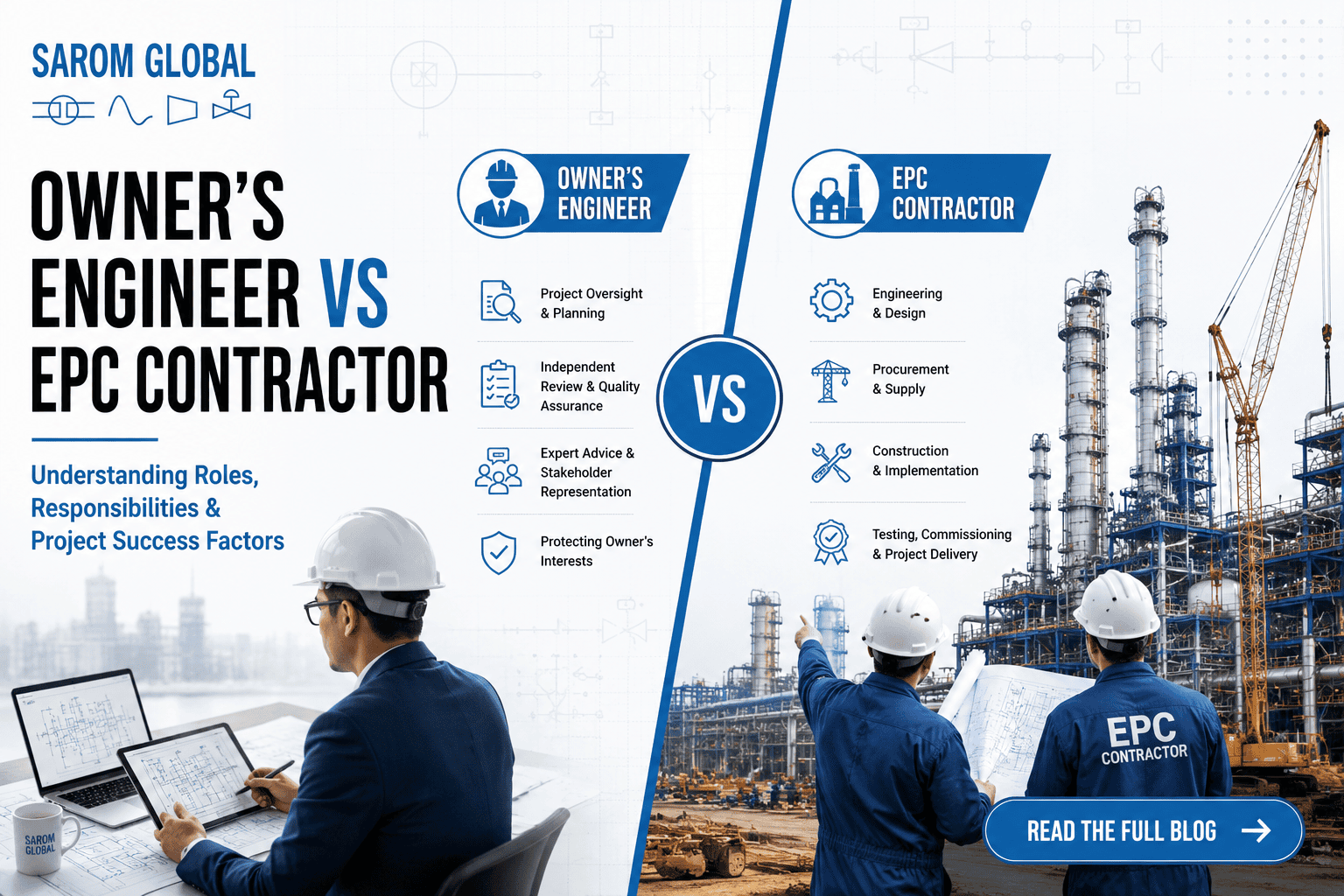
When planning a major capital project — whether it is a power generation facility, a water treatment plant, an oil and gas installation, or an industrial processing plant — one of the first questions project owners face is: who is actually looking after our interests?
Many owners assume that hiring an EPC contractor is enough. The contractor will handle everything, right? Engineering, procurement, construction — it is all in the name. But that assumption creates gaps. Gaps in project governance, technical oversight, and long-term asset performance that only show up after handover, when fixing them costs far more than preventing them ever would have.
Quick Answer: An EPC contractor is responsible for delivering the project. An owner’s engineer independently represents the asset owner’s interests by providing technical assurance, oversight, and risk management throughout the entire project lifecycle. They are not the same role, and they do not serve the same master.
Owner’s Engineer vs EPC Contractor at a Glance
| EPC Contractor | Owner’s Engineer | |
|---|---|---|
| Primary role | Delivers the project | Protects the owner |
| Who they answer to | Their own organisation | The project owner |
| Focus | Contract delivery | Asset lifecycle |
| Manages contractors? | Is the contractor | Reviews the contractor |
| Construction responsibility | Directly responsible | Independent oversight |
| Optimises for | Schedule and cost | Reliability and long-term performance |
Key Takeaways
- EPC contractors deliver projects. Owner’s engineers protect owner interests.
- EPC contractors optimise for delivery within the contract. Owner’s engineers optimise for long-term asset performance.
- These roles are not competing — they are designed to work together.
- Most large capital projects over $10M benefit from engaging both simultaneously.
- The earlier an owner’s engineer is appointed, the greater the value they add.
What Does an EPC Contractor Do?
An EPC contractor takes on full, single-point responsibility for Engineering, Procurement, and Construction. The owner defines the scope. The EPC contractor delivers a turnkey facility that is fully functional and ready for operation.
EPC contracts are typically structured as lump-sum or turnkey agreements. This means the contractor carries the financial risk for cost overruns within the agreed scope. That commercial reality makes cost control, schedule management, and scope management their top priorities — as it should be.
In practice, an EPC contractor will:
- Carry out detailed engineering and develop the full technical design
- Manage procurement of equipment, materials, and services
- Select vendors and subcontractors
- Execute construction and manage all site activities
- Control project schedule and costs
- Hand over a completed, operational facility
This model is widely used across energy projects, water treatment facilities, oil and gas installations, and industrial processing plants. It gives owners a clean delivery path with a single contract and a single point of accountability. For the right project, it is an excellent model.
There is one thing the EPC model does not provide, though. The EPC contractor’s primary obligation is to deliver within the terms of the contract — not to optimise outcomes for the owner beyond those terms. That is the dividing line when comparing owner’s engineer vs EPC contractor responsibilities.
What Does an Owner’s Engineer Do?
An owner’s engineer (OE) is an independent technical advisor hired directly by the project owner. Their job is to represent the owner — not the contractor, not the vendor, not the financier. Just the owner.
Owner’s engineering is not a single task. It is a role that runs across the entire project, from the earliest feasibility work through to commissioning, handover, and often into operations. The owner’s engineer responsibilities change at each phase, but the objective stays the same: make sure every technical and commercial decision serves the owner’s long-term interests.
Front-End Engineering and Feasibility
This is where the most valuable owner’s engineer work happens, and where most owners make the mistake of not yet having one engaged. During FEED (Front-End Engineering Design) and concept development, the owner’s engineer:
- Reviews project feasibility and technical viability
- Assesses concept designs and alternative technology options
- Identifies risks early — before they become expensive to resolve
- Helps define the project execution plan and contracting strategy
- Prepares technical specifications and supports the EPC tender process
- Assists with technical due diligence required by lenders or project financiers
Getting independent engineering input at FEED costs a fraction of what it costs to revisit those decisions during construction.
Design Phase
During detailed engineering, the owner’s engineer provides independent verification that contractor design decisions genuinely serve the owner’s interests — not just the contract:
- Reviews design documents for technical compliance and operational fitness
- Evaluates vendor bids and provides independent procurement oversight
- Assesses whether proposed equipment will hold up across the full asset lifecycle
- Reviews change orders and advises on commercial impact
Construction Phase
During construction, the owner’s engineer serves as the owner’s on-site representative, overseeing progress and quality:
- Monitors contractor progress against schedule and quality benchmarks
- Conducts independent quality assurance and asset integrity checks
- Provides construction management oversight
- Resolves technical issues before they affect the critical path
Commissioning Phase
At commissioning and handover, the owner’s engineer verifies the asset actually works as intended — before the owner signs off:
- Participates in Factory Acceptance Testing (FAT) and Site Acceptance Testing (SAT) to validate equipment performance, functionality, and compliance with project specifications.
- Verifies system performance before handover is accepted
- Confirms the facility meets its performance guarantees
- Manages the defects liability period and operational readiness reviews
Sarom Global provides owner’s engineering services across all of these phases — from front-end feasibility through to commissioning, handover, and ongoing operations.
The Core Difference: Who Each Party Represents
The EPC contractor works for the contracted delivery organisation. Their objective is to deliver the agreed scope safely, on time, and within their contractual obligations. They are accountable for the project. They are not accountable for optimising your asset beyond what the contract specifies.
The owner’s engineer works for you. Their objective is to reduce your technical and commercial risk, verify that contractor decisions are genuinely in your interest, and make sure the asset performs as expected across its full operational life.
The owner’s engineer is the only party on a capital project specifically engaged to represent the owner’s interests — independent of all contractors, vendors, and subcontractors.
This is not a criticism of EPC contractors. They are professional organisations doing exactly what their contract requires. The point is that no contract perfectly aligns a contractor’s commercial interests with an owner’s long-term asset objectives. The owner’s engineer fills that gap.
Speakable definition: An owner’s engineer is an independent engineering advisor who represents the project owner’s interests, while an EPC contractor is responsible for delivering the project under a commercial contract.
Full Comparison: EPC Contractor vs Owner’s Engineer
| Area | EPC Contractor | Owner’s Engineer |
|---|---|---|
| Representation | Contracted delivery organisation | Project owner |
| Main Objective | Deliver scope on time and within contract | Protect owner interests and long-term asset performance |
| Contract Relationship | Lump-sum or turnkey contract with owner | Professional services agreement with owner |
| Accountability | Delivery of contracted scope | Technical assurance and independent project oversight |
| Technical Reviews | Performs detailed engineering | Reviews and audits contractor’s engineering |
| Procurement Involvement | Directly manages procurement and vendors | Evaluates bids and advises owner on procurement decisions |
| Construction Oversight | Directly responsible for construction | Independent monitoring and quality assurance |
| Risk Management | Bears cost and schedule risk within contract | Provides expert advice to the owner on technical, commercial, and asset integrity risks, helping to minimise project and operational uncertainties. |
| Commissioning Support | Executes commissioning and delivers facility | Verifies performance on behalf of owner at FAT and SAT |
| Long-Term Asset Focus | Contractual handover point | Full asset lifecycle and operational requirements |
Planning an EPC or EPCM project over $10M AUD? Engage independent engineering oversight before tendering begins. Book a project governance review with our owner’s engineering team.
When Should You Engage an Owner’s Engineer?
There is no single threshold, but the following situations are strong indicators that independent project oversight is needed. If several apply to your project, the case for owner’s engineering is clear.
- The project value exceeds $10 million AUD
- Multiple contractors, vendors, or work packages are involved
- New or unfamiliar technology is being deployed
- The asset has a long operational life where reliability and maintainability are critical
- Your internal engineering capability is limited or stretched across other projects
- Lenders or investors require independent technical assurance as a condition of financing
- The project involves complex process systems, instrumentation and control, or commissioning
- You are working under an EPC or EPCM contract and want an independent check on contractor decisions
The higher the project complexity and the longer the asset life, the stronger the case for an owner’s engineer from the start.
Why Conflicts of Interest Arise Without Independent Oversight
Conflict of interest in this context does not mean misconduct. The tension is structural. This is an inherent feature of the EPC contract model.
A lump-sum agreement puts the contractor under pressure to control costs, hit milestones, and fulfil their obligations within the agreed price. Those are legitimate commercial priorities. But they can diverge from what the owner actually needs over the life of the asset — things like reliability, ease of maintenance, lifecycle operating costs, and operational flexibility.
Here is a pattern that comes up regularly in Australian energy and industrial projects.
An EPC contractor selects a rotating equipment package that meets the project specification on paper. The decision is contractually compliant. But on review, the selected units have a shorter recommended service interval, higher spare parts cost, and require more specialist maintenance support than the alternative that was a modest premium at procurement. The owner never sees this comparison. They accept handover, and for the next 20 years the additional maintenance cost sits in the operations budget — invisible unless someone goes looking for it.
On one Australian industrial project we reviewed, a contractor-selected equipment package met all specification requirements but increased maintenance intervention frequency by more than 30% compared to an alternative that carried a 12% higher capital cost. The owner’s engineering review during detailed design identified the discrepancy before procurement was finalised. The owner made an informed decision. That is what independent technical oversight exists to do.
This is not a hypothetical risk. Research from the Construction Industry Institute found that quality-related rework discovered during construction carries a total cost impact — including downstream operational consequences — of 10 to 100 times the cost of catching the same issue during design. Independent technical review during FEED and detailed engineering is risk management, not overhead.
Other situations where the absence of independent project oversight creates real problems:
- Change order assessment: EPC contractors submit change orders as a routine part of project delivery. Without an independent reviewer, the owner has no objective basis to assess whether the technical justification is sound or the commercial impact is fair.
- Vendor selection: Procurement decisions made by the contractor can reflect existing supplier relationships rather than the best technical fit for the asset.
- Instrumentation and control integration: Control system architecture decisions made during detailed design have long operational consequences. Poor integration between DCS, instrumentation, and process equipment is one of the most common sources of commissioning delays and early operational failures.
- FAT and SAT requirements: Factory and site acceptance testing requirements that are inadequately specified or not independently witnessed create significant handover risk. Deficiencies that are missed at FAT tend to surface during commissioning, where they are far more expensive and disruptive to resolve.
- Design standards and asset integrity: Designs that meet minimum contractual requirements may not meet the operational and maintenance standards your team will need to work with for 20 or 30 years.
Early engagement of an owner’s engineer surfaces these issues during design — not after handover.
EPC vs EPCM vs Owner’s Engineer: How They Work Together
The owner’s engineer’s role is shaped by the chosen project delivery model, and understanding the differences between EPC and EPCM is essential for appreciating how their responsibilities evolve throughout the project lifecycle.
Under an EPC model, the contractor holds all responsibility for delivery. The owner hands over a defined scope and receives a completed facility. The owner’s engineer provides the independent checks — design reviews, procurement oversight, contractor performance monitoring, and technical assurance at FAT and SAT. The owner’s engineer does not duplicate the EPC contractor’s work. They verify it on the owner’s behalf.
Under an EPCM model, the EPCM contractor manages the project on the owner’s behalf, but the owner retains direct contracts with subcontractors and vendors. This model gives the owner more control but also more complexity in project controls and contract management. The owner’s engineer provides governance support, technical reviews, and owner-side engineering expertise to help manage that complexity — particularly across multi-package projects where coordination risk is high.
| Delivery Model | What the Owner’s Engineer Provides |
|---|---|
| EPC only | Independent design review, procurement oversight, contractor performance monitoring, FAT/SAT assurance |
| EPC + Owner’s Engineer | Full project governance: risk assessment, change order management, design verification, commissioning sign-off |
| EPCM + Owner’s Engineer | Owner-side engineering expertise, governance across multiple packages, independent risk management |
Engaging both an EPC or EPCM contractor and an owner’s engineer is not duplication — it is standard practice on large capital projects. The contractor delivers. The owner’s engineer holds them to account. Together, they create the project governance structure that protects the owner’s investment.
Australian renewable energy, resources, and infrastructure projects have increasingly adopted this model as project complexity has grown and in-house owner engineering teams have become leaner.
Case Study: How Independent Oversight Prevented a Costly Design Decision
Project context: A process facility expansion on the east coast of Australia, delivered under an EPC lump-sum contract.
The issue: During the detailed design phase, the EPC contractor specified a control valve package from a preferred supplier. The valves met the project’s P&ID specifications. However, an independent review of the valve selection — conducted as part of the owner’s engineering scope — identified that the specified trim configuration was unsuitable for the process fluid conditions at partial load. Under normal operating range, the valves would have been subject to accelerated erosion, leading to premature failure and unplanned shutdowns.
The intervention: The owner’s engineering team raised a formal technical query during the design review stage — before procurement was finalised. The EPC contractor reviewed the concern, agreed with the technical assessment, and revised the specification. The replacement valve configuration carried a modest cost premium.
The result: The issue was resolved at zero schedule impact. Had the original specification gone to procurement and the valves been installed, the most likely outcome would have been unplanned downtime within the first 18 months of operation — along with the associated costs of emergency valve replacement, process disruption, and potential safety implications.
This is the practical value of independent engineering oversight. Not adversarial. Not duplicating the contractor’s work. Just an independent set of experienced eyes reviewing decisions before they become fixed costs.
How Sarom Global Supports Owner’s Engineering
At Sarom Global, we work with asset owners across the energy, utilities, oil, and gas sectors to provide independent engineering support across the full project lifecycle. Our team brings multidisciplinary capability across process engineering, instrumentation and control, FAT and SAT commissioning support, plant optimisation, digitalisation, and forensic failure analysis.
Because our team has direct experience working across the full project delivery cycle — including detailed design, procurement, commissioning, and operations — we know where EPC contracts create risk for owners, and we know what to look for.
What that delivers for capital projects:
- Better project governance: Independent technical review at every project phase, from FEED and concept design through to commissioning and handover.
- Reduced project risk: Early identification of technical, procurement, and operational risks before they become expensive to fix.
- Improved operational readiness: FAT and SAT participation to verify that systems are tested and performing before the asset enters service.
- Stronger technical assurance: Independent review of design documents, vendor submissions, and contractor decisions — assessed through the lens of your long-term operational requirements, not just what the contract requires.
Whether you are structuring a new capital project, managing an active EPC contract, or looking to strengthen oversight on a project already underway, experienced owner’s engineering support changes project outcomes.
Frequently Asked Questions
Conclusion
The owner’s engineer vs EPC contractor question is not a technical detail. It is a fundamental question of project governance: who is independently accountable to you throughout the project?
EPC contractors deliver projects. They bring engineering depth, procurement scale, construction capability, and turnkey delivery under a single contract. That is genuinely valuable.
Owner’s engineers protect your interests. They provide the independent technical assurance, risk management, and project oversight that makes sure you get the outcome you are investing in — not just the outcome the contract specifies.
These roles are not in competition. The most successful capital projects in Australia’s energy, utilities, oil and gas, and industrial sectors use both. The contractor delivers. The owner’s engineer verifies that delivery on the owner’s behalf.
Engage your owner’s engineer early. The further into a project you get before appointing independent technical oversight, the more limited that oversight becomes. The best time to start is at FEED. The second best time is now.